Exploring the Heart of Hydraulic Systems: Adapter Couplings
Delve into the core of hydraulic systems with adapter couplings, the essential components that create seamless connections between hoses and conduits. Discover how these adapters provide smart solutions for component mismatches, eliminating the need for direct replacements. Gain professional insights on how to identify couplings, understand industry standards, and navigate brand compatibility.
What is an Adapter Coupling?
In hydraulics, adapter couplings are specialized components designed to join hoses, pipes, and tubes, ensuring the efficient and leak-free flow of hydraulic fluid under pressure. Their primary role is to bridge connections between conductors that differ in diameter, gender, or thread type.
A common challenge arises when two quick-disconnect coupling halves are incompatible due to differing profiles, sizes, or because both are the same gender (e.g., two female ends). Permanently replacing one half is often impractical for temporary needs, such as attaching various farm implements to a skid steer loader. Hydraulic coupler adapters offer a perfect workaround, enabling the connection of two mismatched quick couplings without any replacement.
These adapters connect to a quick-release coupling on both ends, effectively serving as a bridge between two otherwise incompatible units. While the adapter introduces two additional valves, causing a slight pressure drop, this is generally an acceptable trade-off for the significant time saved and operational flexibility gained.
Users simply need to determine the size and profile of their two existing coupling halves to select the appropriate coupler adapter.
How to Identify a Hydraulic Coupler
Correctly identifying a hydraulic coupler requires checking several key characteristics:
-
Verify Interchangeability Standards: Most couplers conform to industry standards that guarantee interchangeability. Key standards include the ISO 7241 series (A and B) and ISO 16028. Online tools, like the identifier available on the Faster website, can greatly simplify this process.
-
Determine the Size: Accurately measuring the coupler's dimensions is crucial. The aforementioned identification tools are also designed to assist with this step.
-
Look for Markings: Many couplers feature engraved markings, labels, or stamped symbols that indicate their type, size, and specifications. Always check for these identifying features.
Advantages of Feiman Hydraulic Coupler Adapters
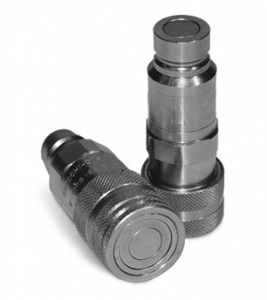
Feiman hydraulic coupler adapters are engineered for high performance and versatility. They enable seamless conversion between ISO 16028 flat-face couplers and Ag ISO 7241-A poppet style couplers. Characterized by an extremely compact design and performance on par with standard quick couplings, these adapters represent a premium solution in their category.
Maximizing Hydraulic System Efficiency: A Guide to Quick Coupler Installation
Hydraulic Fluids: Power, Applications, and Inherent Risks